Learning the art of the bean at Honduras’ finest coffee plantation
Originally published in Lexus Magazine - by Mark Anders | Photography by Chris M. Rogers
 |
| A perfect cup of cappuccino served up by Guillermo Calderón, the Barista Cowboy. |
The finca’s Guamos, or shade trees, help to produce some of the most savory Arabica coffee on the planet.
I’m kneeling in the dirt, straddling a long line of tiny leafy coffee plants. There are 25,000 of them here, rows upon rows, planted inside small black plastic bags each the size of my fist. A low, black tent-like structure protects the seedlings from the strong Honduran sun, which is already blazing and it’s only eight in the morning.
 |
| The author rides off to survey coffee plants at Finca Santa Isabel. Removing weeds from young coffee plants. |
This is the plant nursery. Soon these
“small soldiers,” as the workers call them, will be planted in some lush tropical plot on
Finca Santa Isabel, the 375-acre
Café Welchez coffee plantation in the northwest corner of the country, close to the Guatemalan border.
This is where I’ll be working for the next few days. For now, it’s my job to remove the weeds hat are infiltrating these bags. They call it
“cleaning.” Working alongside me is Gregorio Lopez, a 12-year veteran of the finca. He’s teaching me proper weeding technique. Meanwhile I chat him up in my marginal Spanish. I probably should have concentrated more on the task at hand because suddenly my translator, Edgar Carranza, approaches, looking concerned.
Edgar, who is 19 years old, leads coffee tours on the plantation.
“You see,” he says solemnly,
“there is quite a situation here.” He nods towards Gregorio.
“He’s saying that you might have taken out some other good plants.”
“I pulled the wrong ones?”
“Yes, apparently you took out one that’s actually a small oak tree. They use it to build things on the farm.”
“Crap. I’m sorry. I’m already messing up.”
“That’s right,” says my friend Chris, camera in hand.
“All of a sudden the coffee is going to be a hell of a lot more expensive.” Still chuckling, I get back to my weeding, but now with more resolve. I want to prove to Memo that I’m ready to move on to the next job.
Memo is short for Guillermo Calderon, but I call him Jefe Grande—Spanish for
“Big Boss.” He’s 35, manager of the plantation, and though he seems like a serious, down-to-business kind of guy, the first time I called him Jefe Grande, he cracked a big smile. Memo is all cowboy. He’s six feet tall, 230 pounds, and carries himself with a confidence you’d expect from a man who operates a huge farm like this. But he’s also a gentleman farmer, an accountant turned classically trained barista. He can pour all sorts of elaborate designs in cappuccinos, and is highly knowledgeable about the coffee growing process. He’s a man of many names, so I add one more—I think of him as the Barista Cowboy.
Memo deftly leads me through it all, spouting off stats about soil samples and nitrogen and potassium content of the dirt. He talks of optimum humidity levels and elevation and organic fertilizer. The salient points are that Finca Santa Isabel, a 50-year-old farm, is predominantly a shade-grown, organic plantation. Unlike clear-cut coffee farms that are harvested by machine, this finca has guamos, or shade trees, that shield the coffee trees from heavy sunlight and provide a flourishing insect and bird habitat
(with 80 species of birds) that eliminates the need for chemical fertilizers and pesticides. The result:
an Earth-friendly process that produces some of the most savory Arabica coffee on the planet.
“Mark, come!” booms Memo, gesturing for me to follow. I have to jog a little to catch up, while our small entourage—Edgar, Gregorio, and two other caporales (supervisors) from the farm—trails behind.
 |
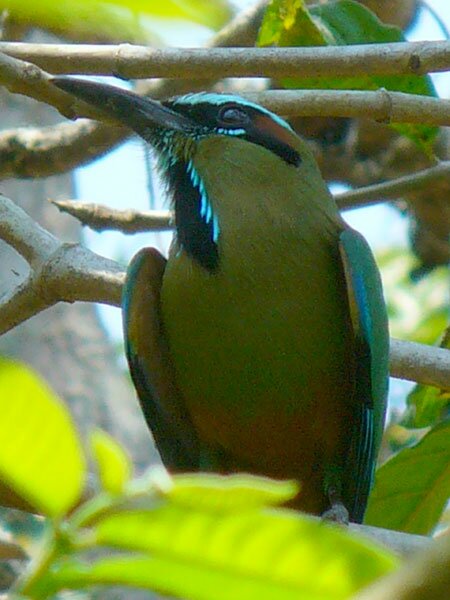
| Honduran wildlife, coffee tour bus, hand-crafted boots, traditional dress, Copan Ruins, and “Big Boss” Guillermo Calderon. |
To the rest of the workers, I’m Gringo Loco— literally,
“Crazy White Guy.” They think I’m crazy because I actually want to work on the plantation. This is tough, getting-your-hands-dirty kind of work, and most gringo tourists would rather cruise the finca on the tour bus and stroll around the plantation with Edgar. Meanwhile, I spray coffee plants with organic fertilizer, dig for worms in piles of rich, pungent compost made of coffee bean pulp, and clear brush and weeds from around mature coffee trees with a machete. This is serious labor and my triceps are burning. I also dig holes with a posthole digger. A skilled worker can do 300 in a day—but I do six and I’m ruined. Then I transplant the young coffee plants. Next, one of the caporales shows me how to use a machete to trim the tops off the coffee trees to keep them low enough for the pickers. They call this method
“rock and roll” since experienced workers can quickly top a row of trees, one after another.
By lunchtime each day, I’m starving. We gather at Las Cascades, the finca’s treehouse-like café secreted within a thick rainforest. One afternoon as I burst into the café with Memo, muddy and sweaty with my rubber boots and cowboy hat, I get quizzical looks from the tourists on the official coffee tour. I may look out of place, like I’m playing cowboy, but I feel proud—cool even—because I’m rolling with the Jefe.
 |
| The Honduran coffee bean journey, from picking to roasting: Harvesting coffee, red beans, sun-drying process, and roasted beans. |
“Este es Café de Mark,” the boss tells me as i scatter the beans.
Together we eat a brilliant plato típico, or typical Honduran food. There’s tender locally raised beef and Chicharones, homemade corn tortillas, green chiles, lightly fried plantains, and, of course, the coffee. Memo brings me a delicately poured cappuccino with an intricate spider web he’s drawn into the foam with chocolate syrup. And then he delivers me a rich, piping hot espresso. All perfect.
“Some testers say his coffee has a lot of spices other than chocolate, like a peach taste,” Edgar says, translating for Memo.
“He’s saying it’s due to the work of the bees. They go around from flower to flower, like to citrus trees, lemons, other types of plants, and then back to the coffee plants, and that’s pretty much how these spices travel around in the coffee.”
Later we tour the farm by horse, galloping up and down steep pitches of rainforest, through narrow streams, and alongside rows of mature trees being harvested by teams of workers. Ever the cowboy, Memo packs his black steel pistol in a holster on his hip—
“for security” he says.
In the late afternoon, as most of the workers pile into the beds of pickup trucks for their commute home, I join Memo and about a dozen other workers for a game of pelota, a fast-paced form of soccer played on the slick concrete pad where the farm’s coffee beans are sun dried.
These are the first few days of the harvest season and I can tell Memo is excited. For the next three months he’ll work from dawn to dusk supervising more than 300 workers as they pluck the valuable berries from the trees. An experienced picker can harvest 200 pounds a day, and every season Santa Isabel produces up to 5,000 sacks—a total of between 400,000 and 500,000 pounds—of coffee beans. Honduras is only the 10th-largest producer of coffee in the world, but thanks to fincas like this one, the country has quickly become known for its rich, pure beans, which are snapped up mostly by Europe and Japan. They may not have the Juan Valdez–size advertising budget of the Colombian coffees, but in-the-know baristas and connoisseurs revere Honduran coffee.
Not all of the berries at Santa Isabel have ripened into their characteristic red and yellow colors, but there’s still plenty of activity on the farm. Workers emerge from the thick green foliage, each with his own waist-mounted plastic bucket for carrying the berries he’s picking at the moment, plus a big yellow burlap-like sack for his entire day’s harvest. Using both hands simultaneously, each picker deftly twists the ripe berries and pops them into the bucket. In the afternoon, they all meet in an open-air pavilion where the daily weigh-in happens. Memo presides over it all, flanked by Alexa, a cocoa-eyed, 22-year-old woman who tallies each worker’s harvest, both by number of gallons and quality of the berries picked.
One by one the workers proudly pour their sacks into the hopper. The beans look like marbles and I enjoy running my fingers through them. Memo asks me to hold my foot on the trapdoor as he judges each harvest. The workers hold their breath slightly and wait for his verdict. I can sympathize with them because I too have taken my turn harvesting and then presenting my meager haul to Memo, garnering a mixed review. Too many greens, he often scowls, but occasionally he offers praise. Then with a curt adios he tells me to lift my foot and send the berries tumbling down a chute to the holding tank below. Next, a machine groans to life and begins separating the good berries from the bad.
 |
| Rancho Las Cascadas Cafe at the Finca Santa Isabel plantation. |
Each berry contains two coffee beans, and it takes extensive washing to remove the thick, fibrous husk. After the beans are washed, they are sent through a neatly tiled water canal system with a series of locks and dams that separate the husks and pulp from the beans. After that the beans are sent to another vat where they are left to ferment for 12 to 40 hours. Some plantations skip this process but Memo insists that it is the key to superior aroma and taste. Like a kid, I slop around in the vat with beans up to my knees before sending them down another chute where they’re staged for drying.
It takes five days to dry beans on the soccer field, three days on drying tables inside a greenhouse, or just 40 hours in the drying machine. Most are dried using a combination of all three methods before their 17 minutes of roasting, which brings the inner temperature of the beans to around 390 Fahrenheit, thereby producing their medium–dark brown color.
Out on the concrete soccer pitch in the bright afternoon sun, I get a huge batch of beans ready for roasting. I’m pushing them gently back and forth with a handmade wooden rake, turning them over for more sun. The rhythmic flow to it becomes hypnotic—part meditation exercise, part hockey rink Zamboni duty. All the while I recall the people I’ve met on the farm, and the work I’ve done over the past couple days, and that’s when I start to truly appreciate the magnitude of work and sweat that goes into producing each cup of coffee.
“Este es café de Mark,” Memo says as I scatter the beans.
Even with my lackluster Spanish, little is lost in translation: This is Mark’s coffee. Funny, but true. I can’t help but smile as I realize that soon, somewhere, maybe at a tiny sidewalk café in Paris or in a Starbucks in the States, someone will indeed be enjoying the fruits of my labor
.
IF YOU GO
GETTING THERE
The quaint cobblestone village of Copan Ruinas is about 2.5 hours from the airport in San Pedro Sula, Honduras. MC Tours - Honduras (mctours-honduras.com) can arrange for an escorted tour, accommodations and/or private transportation within the country.
STAY
Hotel Marina Copan is a warm, 51-room boutique hotel ideally situated beside the town’s main plaza, with plenty of good shopping and restaurants nearby. (hotelmarinacopan.com)
EXPERIENCE
Take the Copan Coffee Tour at Finca Santa Isabel, which includes a bilingual guide; breakfast, lunch, or brunch at Rancho Las Cascadas; and a shuttle to and from the Copan Ruinas. (cafehonduras.com) Explore the Parque Arquelogico Ruinas de Copan, site of one of the most elaborate cities of the Mayan Empire.
TASTE
Try Welchez Copan Gourmet Coffee for yourself. The online store offers light and dark roast, whole bean or already ground. (cafehonduras.com)