Spiga

Showing posts with label Central America. Show all posts

Harpy eagle nest spotted in Honduras!


Harpy eagle juvenile - Photo by: David Medina

Those who have seen a harpy eagle in the wild can consider themselves extremely lucky. The harpy eagle, the second-largest bird in the planet, hides within the more dense forests of Central and South America, procreate only once every four or five years, and they build their nests hidden in trees above 25-30 meters (80-100 feet), so seeing them is nearly impossible.
Harpy eagle - Photo by: David Medina
This is why the news of finding an active Harpy Eagle nest with a chick is just stunning. This is the first nest found in Honduras, and the third documented throughout Central and North of Panama. Other places where these nests have been seen are Guatemala and Belize.
Harpy eagle - Photo by: David Medina
Patuca National Park in Eastern Honduras, the largest protected area in the country (375,584 hectares : 928,088 acres), created in december 1999, is one of many tropical protected areas where intense preservation projects are taking place, and despite the lack of adequate funding, a handful of scientists conscious and nature enthusiasts, who are part of both Honduran and foreign entities have been conducting important conservation and reforestation efforts which are worthy of praise.
Harpy eagle - Photo by: David Medina

The sighting of this harpy eagle and her newborn has risen the villagers 'pride', increasing conservation awareness among the residents of the surrounding area as well. This important event is a gratifying sign that the continuing efforts of the agencies responsible for the preservation of the area are being productive, since it is well known by experts that the harpy eagle needs at least 150Km2 (58 square miles) of lush forest free of human contact in order to survive.

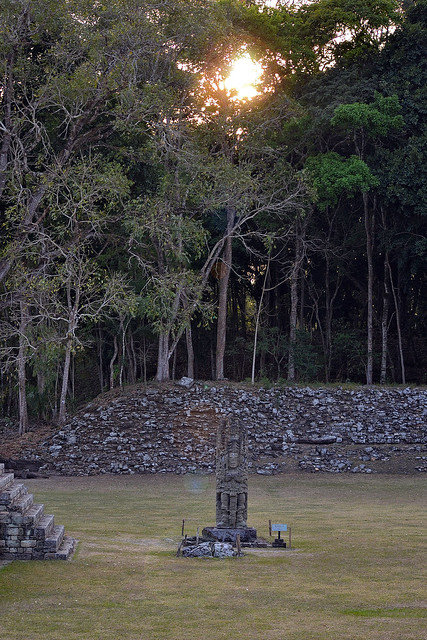
Sunset during spring equinox in Copan

In Copan Archeological Park there is a Ceremonial Court just north of the Temple 4 and the Main Plaza. During the spring equinox, the stelas "F" and "C" in that court, --properly called now "Plaza del Sol" (Plaza of the Sun)-- look pretty much aligned with the sun at sunset, around 5:45pm. You need to make special arrangements with the Archeological Park authorities though, because the Park officially closes at 4pm. Quite an impressive view!

Stela "A" Copan, a photo by Adalberto.H.Vega on Flickr.


Castillo de San Felipe, Rio Dulce, Guatemala

An amazing colonial structure rises in the Lake Izabal, Guatemala, near Rio Dulce, one of the nicest spots in eastern Guatemala, where you can spend a couple of days exploring the surroundings and having a most exciting boat ride downstream  Rio Dulce through the gulf ending in the quaint little Garifuna village of Livingston.

The Castillo de San Felipe de Lara is a Spanish colonial fort located at the entrance to Lake Izabal in eastern Guatemala. Lake Izabal is connected with the Caribbean Sea via the Dulce River and El Golfete lake. King Philip II of Spain ordered the fort to be erected in an attempt to reduce pirate activity in the area.

This site was added to the UNESCO World Heritage Tentative List on September 23, 2002 in the Cultural category. (via Wikipedia)
Overlooking the Lake Izabal

"Castle of San Felipe de Lara, it is composed for defensive strength that watched over the entrance to the old Kingdom of Guatemala from the Caribbean sea, built during the time of Spanish dominance (1524-1821). This construction has served from protection to important cultural goods for the reconstruction of the history of this type of monuments. It is connected in a natural, simply impressive landscape." ~via UNESCO
Interior passage

Honduras's Top 5 Best Destinations


Located right in the middle of Central America, Honduras has plenty of different touristic sites for varied interests. From archaeological sites and towns with colonial buildings to almost a quarter of territory turned into protected areas for nature lovers, beautiful beaches spanning over 500 miles of its Caribbean North coast and crystal-clear warm water coupled with bleached sand beaches at the Bay Islands, a section of the Mesoamerican barrier reef, second largest of its kind in the world and first in biodiversity; living cultures that bear ancient traditions and authentic cultural heritage, and certainly the friendliest people in the region.

1. Copan

Copan Ball Court
Ball Court and Main Plaza, Copan Ruinas
Copán Ruinas is the prime destination in Honduras mainland. A small town with cobblestone streets, a multicultural ambiance typical of a regularly visited destination, yet not too crowded so as to still be enjoyed. As opposed to many other archaeological destinations, the main archaeological site is a short walk from town, just about ten city blocks away and you will find yourself in the UNESCO World Heritage Site of Copan, with a magnificent display of particularly unique sculpture works, even for general Maya art displays.

The southernmost Maya city–state of Copan flourished during a major Classic period from the 5th to 9th centuries AD, when Maya art and science development reached its peak just before mysteriously vanishing. You can enjoy a one-hour easy walk through the park, preferably with a local Tour Guide who will let you deep into the story of this fascinating place.

The Maya Sculpture Museum is one of the best in the region, holding the highest detail in original pieces found in the site protecting them from the elements as well as a full size replica of the Rosalila Temple, discovered in the late 80s, one of the intact temples preserved underneath one of the structures in the main site.

Besides the archaeological park, Copan has plenty of activities to keep you busy for a couple more days. There is the Copan Coffee Tour, a nice hike through shade grown coffee plantations under huge elderly trees inside an authentic primary rainforest just a 30-minute drive from town. Here you can learn about the harvesting and processing of this known bean variety that has become a key to most of our lifestyles.

At the Macaw Mountain Bird Park Reserve you will watch over 200 birds from different species such as macaws, parrots, toucans, owls, and hawks; some are flying freely in the park while others are kept inside spacious aviaries, and you can even have an encounter with some lucky ones at the interaction area. Most of these birds have been rescued from smugglers or donated from people who had them as pets, and since they were not able to survive alone in the wild, they are taken care of in the park.

The Luna Jaguar Hot Springs and Spa 50 minutes from town provides all necessary elements for a relaxing afternoon soothing your body, and for the more active people there is the Los Sapos Canopy Tour with 14 zip-lines (one of them over half a mile long and 650 feet above the ground) qualified by some people as one of the best in Central America.

2. Roatan and Utila

West Bay Beach
West Bay Beach at Roatan, Bay Islands
If you are more into enjoying sand and sea, Roatan will be the best choice. Pristine water and sugar-white sand are waiting for you at some of the best beaches this side of America. And for divers and snorkelers, the Mesoamerican Barrier Reef System is just a fin stroke away from the beach, as opposed to many other diving destinations where you are forced to take a boat ride to get to the good spots.

The Gumbalimba Natural Park has a zip-line, a jungle with a lagoon and an interaction area with monkeys and macaws, a nice hanging bridge and water sports, all available to spend a nice full day of fun and adventure. You can also visit a nice cameo factory, where you can see the ancient delicate art of carving mythical images in sea shells. There is also an iguana farm, glass bottom boat tours and dolphin encounters available for you.

Utila, the smallest of the Bay Islands is a true heaven for divers, it is the less expensive place in the planet to get PADI certification, a preferred spot for the impressively giant whale shark and plenty of marine life, still a truly enjoyable paradise not crowded at all.

3. Tela

Lancetilla Botanical Garden
Lancetilla Botanical Garden, Tela
One hour from San Pedro Sula, the main touristic gateway in the country is Tela, an old town that flourished during the banana boom of the 30s when Honduras was the main exporter of this exotic fruit, earning its popular title “Banana Republic”. Tela is located in the north Caribbean coast of Honduras.

There are nice fully appointed resorts to enjoy some sunny days, and there are also four different protected areas in the surroundings: Jeannette Kawas National Park; accessible only by water, this park has some of the nicest beaches around and totally off the beaten path to have them only for you, there is plenty of wildlife to be seen such as howler, white-faced, and spider monkeys, alligators, many aquatic birds and (if you are lucky) some dolphins along the boat on the way in. Los Micos Lagoon is a place to go on a motor boat right past the Garifuna village of Miami where you can visit a Garifuna Museum and interact with the ethnic locals during their daily life.

Tela is also home to the Lancetilla Botanical Garden, the second largest botanical garden in the world, holding a wide variety of plants and trees from around the globe. This garden was built as a research facility by one of the banana companies and is now maintained by the government. The Punta Izopo Wildlife Reserve is an intricate maze of mangroves where you can kayak along to enjoy the peace of this remote area while watching some abundant wild life.

4. La Ceiba

Cangrejal River Rafting
Cangrejal River Rafting, La Ceiba
One hour east of Tela and you will stumble upon La Ceiba, owner of the properly earned title: “the Ecotourism Capital” of Honduras. In La Ceiba you have the chance to visit Pico Bonito National Park, a true paradise for birdwatchers -one of the biggest most intact contiguous forest in this part of the world, with confirmed sightings of more than half of the nearly 800 birds known to Honduras. The highest elevation in the shortest distance from sea level, Pico Bonito has several nicely maintained nature trails for all levels of hiking and trekking, some canopy tours, and from The Lodge at Pico Bonito -featured in the Small Luxury Hotels of the World list- you can find a few  nice bird-watching towers to easily appreciate some of the over 400 species that wander freely in this cloud forest including the elusive Lovely Cotinga.   

Cuero y Salado Wild Life Refuge is a coastal manatee and wildlife refuge where the Cuero and Salado Rivers meet the ocean. The refuge contains over 13 square kilometers of tropical wet and mangrove forests. Monkeys, sloths, caimans, crocodiles, iguanas, and turtles are common sights together with over 350 species of birds. The refuge's most famous inhabitant is the elusive and endangered West Indian Manatee with an estimated population of 50 individuals. From the La Ceiba international airport you can fly to Roatan, Utila or Guanaja (the other two Bay Islands), although they can also be reached by a nice passenger’s speed-boat.

For those searching adrenaline kicks, the Cangrejal River offers class 4 and 5 rapids for one of the best white-water river rafting experiences. Last but not least from La Ceiba is Cayos Cochinos, an archipelago of several small cays all part of a protected area which has guaranteed a truly secluded experience in one of the most paradisaical spots around.

5. The Lenca Trail

Cathedral Santa Rosa de Copan
Cathedral from Central Plaza, Santa Rosa de Copan
If your interest is more into the cultural side, the Lenca Trail offers a nice itinerary, covering some of the nicest old colonial towns including Comayagua, former capital city of Honduras. With some nice colonial churches and buildings, one of the Comayagua Cathedral towers holds the oldest clock in our continent; La Esperanza, a small town in the Honduran highlands where local Lenca people from the surrounding villages gather together on Sundays to exchange market goods; Gracias, former capital city in the days of the Central American Vice-royalty, home to some nice old churches, the San Cristobal fortress dating from colonial times and the Casa Galeano Museum; and Santa Rosa de Copan, a nice small city which flourished greatly during the republican period, right after independence days when the tobacco industry began to take off, the city tour includes a visit to some nice old buildings and a tobacco factory.

----------

Honduras is a little less than 3 hours from main gateways in the United States by flight, with four international airports receiving daily flights from major airlines, being San Pedro Sula the main aerial entry for tourism. Getting around is easy, there is deluxe transportation service available, and private services can easily be arranged as well. There are hotels for every budget, and the locals are very friendly. English is widely spoken in Copan and Roatan and also by the staff of important hotels throughout the country.

The Church and Central Plaza, Copan Ruinas

The Central Plaza in Copan Ruinas, Honduras is going through some radical transformations. Apparently the municipal authorities had finally come to their senses and realized that the Central Plaza in a small town like Copan Ruinas should not have that many ornaments and walls inside.

It is the same situation as any other town in Honduras (or Latin America) that has the typical layout of the Spanish cities, with the church opposite to the government building. The Central Plaza doesn't have any walls or tall edifications inside, because buildings around have even more historical value to be appreciated from the plaza itself.

Although a properly maintained—beautifully adorned Central Plaza contributes to the embellishment of the city, Central Plazas should not be crowded with vision-obstructive elements that impede the view of those historically valuable buildings.

The actual Plaza with all those decorations inside (and an unnecessary wall in the south side) was created by the same architect who designed the Central Plaza in Puerto Cortes, but the difference in that city as compared to Copan —no offense to the Porteños— is that the only pretty element in the city is the Plaza itself. There are no historical buildings around worthy of singular appreciation.

Let's hope the remodeling process won't suffer the same interference as the so—called garden refurbishing.

Welchez Coffee and Copan Coffee Tour ~via Lexus Magazine


Learning the art of the bean at Honduras’ finest coffee plantation

Originally published in Lexus Magazine - by Mark Anders | Photography by Chris M. Rogers

A perfect cup of cappuccino served up by Guillermo Calderón, the Barista Cowboy.

The finca’s Guamos, or shade trees, help to produce some of the most savory Arabica coffee on the planet.

I’m kneeling in the dirt, straddling a long line of tiny leafy coffee plants. There are 25,000 of them here, rows upon rows, planted inside small black plastic bags each the size of my fist. A low, black tent-like structure protects the seedlings from the strong Honduran sun, which is already blazing and it’s only eight in the morning.

The author rides off to survey coffee plants at Finca Santa Isabel. Removing weeds from young coffee plants.
This is the plant nursery. Soon these “small soldiers,” as the workers call them, will be planted in some lush tropical plot on Finca Santa Isabel, the 375-acre Café Welchez coffee plantation in the northwest corner of the country, close to the Guatemalan border.

This is where I’ll be working for the next few days. For now, it’s my job to remove the weeds hat are infiltrating these bags. They call it “cleaning.” Working alongside me is Gregorio Lopez, a 12-year veteran of the finca. He’s teaching me proper weeding technique. Meanwhile I chat him up in my marginal Spanish. I probably should have concentrated more on the task at hand because suddenly my translator, Edgar Carranza, approaches, looking concerned.

Edgar, who is 19 years old, leads coffee tours on the plantation. “You see,” he says solemnly, “there is quite a situation here.” He nods towards Gregorio. “He’s saying that you might have taken out some other good plants.”

“I pulled the wrong ones?”

“Yes, apparently you took out one that’s actually a small oak tree. They use it to build things on the farm.”

“Crap. I’m sorry. I’m already messing up.”

“That’s right,” says my friend Chris, camera in hand. “All of a sudden the coffee is going to be a hell of a lot more expensive.” Still chuckling, I get back to my weeding, but now with more resolve. I want to prove to Memo that I’m ready to move on to the next job.

Memo is short for Guillermo Calderon, but I call him Jefe Grande—Spanish for “Big Boss.” He’s 35, manager of the plantation, and though he seems like a serious, down-to-business kind of guy, the first time I called him Jefe Grande, he cracked a big smile. Memo is all cowboy. He’s six feet tall, 230 pounds, and carries himself with a confidence you’d expect from a man who operates a huge farm like this. But he’s also a gentleman farmer, an accountant turned classically trained barista. He can pour all sorts of elaborate designs in cappuccinos, and is highly knowledgeable about the coffee growing process. He’s a man of many names, so I add one more—I think of him as the Barista Cowboy.

Memo deftly leads me through it all, spouting off stats about soil samples and nitrogen and potassium content of the dirt. He talks of optimum humidity levels and elevation and organic fertilizer. The salient points are that Finca Santa Isabel, a 50-year-old farm, is predominantly a shade-grown, organic plantation. Unlike clear-cut coffee farms that are harvested by machine, this finca has guamos, or shade trees, that shield the coffee trees from heavy sunlight and provide a flourishing insect and bird habitat (with 80 species of birds) that eliminates the need for chemical fertilizers and pesticides. The result: an Earth-friendly process that produces some of the most savory Arabica coffee on the planet.

“Mark, come!” booms Memo, gesturing for me to follow. I have to jog a little to catch up, while our small entourage—Edgar, Gregorio, and two other caporales (supervisors) from the farm—trails behind.

Honduran wildlife, coffee tour bus, hand-crafted boots, traditional dress, Copan Ruins, and “Big Boss” Guillermo Calderon.

To the rest of the workers, I’m Gringo Loco— literally, “Crazy White Guy.” They think I’m crazy because I actually want to work on the plantation. This is tough, getting-your-hands-dirty kind of work, and most gringo tourists would rather cruise the finca on the tour bus and stroll around the plantation with Edgar. Meanwhile, I spray coffee plants with organic fertilizer, dig for worms in piles of rich, pungent compost made of coffee bean pulp, and clear brush and weeds from around mature coffee trees with a machete. This is serious labor and my triceps are burning. I also dig holes with a posthole digger. A skilled worker can do 300 in a day—but I do six and I’m ruined. Then I transplant the young coffee plants. Next, one of the caporales shows me how to use a machete to trim the tops off the coffee trees to keep them low enough for the pickers. They call this method “rock and roll” since experienced workers can quickly top a row of trees, one after another.

By lunchtime each day, I’m starving. We gather at Las Cascades, the finca’s treehouse-like café secreted within a thick rainforest. One afternoon as I burst into the café with Memo, muddy and sweaty with my rubber boots and cowboy hat, I get quizzical looks from the tourists on the official coffee tour. I may look out of place, like I’m playing cowboy, but I feel proud—cool even—because I’m rolling with the Jefe.

The Honduran coffee bean journey, from picking to roasting: Harvesting coffee, red beans, sun-drying process, and roasted beans.
“Este es Café de Mark,” the boss tells me as i scatter the beans.

Together we eat a brilliant plato típico, or typical Honduran food. There’s tender locally raised beef and Chicharones, homemade corn tortillas, green chiles, lightly fried plantains, and, of course, the coffee. Memo brings me a delicately poured cappuccino with an intricate spider web he’s drawn into the foam with chocolate syrup. And then he delivers me a rich, piping hot espresso. All perfect.

“Some testers say his coffee has a lot of spices other than chocolate, like a peach taste,” Edgar says, translating for Memo. “He’s saying it’s due to the work of the bees. They go around from flower to flower, like to citrus trees, lemons, other types of plants, and then back to the coffee plants, and that’s pretty much how these spices travel around in the coffee.”

Later we tour the farm by horse, galloping up and down steep pitches of rainforest, through narrow streams, and alongside rows of mature trees being harvested by teams of workers. Ever the cowboy, Memo packs his black steel pistol in a holster on his hip—“for security” he says.

In the late afternoon, as most of the workers pile into the beds of pickup trucks for their commute home, I join Memo and about a dozen other workers for a game of pelota, a fast-paced form of soccer played on the slick concrete pad where the farm’s coffee beans are sun dried.

These are the first few days of the harvest season and I can tell Memo is excited. For the next three months he’ll work from dawn to dusk supervising more than 300 workers as they pluck the valuable berries from the trees. An experienced picker can harvest 200 pounds a day, and every season Santa Isabel produces up to 5,000 sacks—a total of between 400,000 and 500,000 pounds—of coffee beans. Honduras is only the 10th-largest producer of coffee in the world, but thanks to fincas like this one, the country has quickly become known for its rich, pure beans, which are snapped up mostly by Europe and Japan. They may not have the Juan Valdez–size advertising budget of the Colombian coffees, but in-the-know baristas and connoisseurs revere Honduran coffee.

Not all of the berries at Santa Isabel have ripened into their characteristic red and yellow colors, but there’s still plenty of activity on the farm. Workers emerge from the thick green foliage, each with his own waist-mounted plastic bucket for carrying the berries he’s picking at the moment, plus a big yellow burlap-like sack for his entire day’s harvest. Using both hands simultaneously, each picker deftly twists the ripe berries and pops them into the bucket. In the afternoon, they all meet in an open-air pavilion where the daily weigh-in happens. Memo presides over it all, flanked by Alexa, a cocoa-eyed, 22-year-old woman who tallies each worker’s harvest, both by number of gallons and quality of the berries picked.

One by one the workers proudly pour their sacks into the hopper. The beans look like marbles and I enjoy running my fingers through them. Memo asks me to hold my foot on the trapdoor as he judges each harvest. The workers hold their breath slightly and wait for his verdict. I can sympathize with them because I too have taken my turn harvesting and then presenting my meager haul to Memo, garnering a mixed review. Too many greens, he often scowls, but occasionally he offers praise. Then with a curt adios he tells me to lift my foot and send the berries tumbling down a chute to the holding tank below. Next, a machine groans to life and begins separating the good berries from the bad.

Rancho Las Cascadas Cafe at the Finca Santa Isabel plantation.
Each berry contains two coffee beans, and it takes extensive washing to remove the thick, fibrous husk. After the beans are washed, they are sent through a neatly tiled water canal system with a series of locks and dams that separate the husks and pulp from the beans. After that the beans are sent to another vat where they are left to ferment for 12 to 40 hours. Some plantations skip this process but Memo insists that it is the key to superior aroma and taste. Like a kid, I slop around in the vat with beans up to my knees before sending them down another chute where they’re staged for drying.

It takes five days to dry beans on the soccer field, three days on drying tables inside a greenhouse, or just 40 hours in the drying machine. Most are dried using a combination of all three methods before their 17 minutes of roasting, which brings the inner temperature of the beans to around 390 Fahrenheit, thereby producing their medium–dark brown color.

Out on the concrete soccer pitch in the bright afternoon sun, I get a huge batch of beans ready for roasting. I’m pushing them gently back and forth with a handmade wooden rake, turning them over for more sun. The rhythmic flow to it becomes hypnotic—part meditation exercise, part hockey rink Zamboni duty. All the while I recall the people I’ve met on the farm, and the work I’ve done over the past couple days, and that’s when I start to truly appreciate the magnitude of work and sweat that goes into producing each cup of coffee. “Este es café de Mark,” Memo says as I scatter the beans.

Even with my lackluster Spanish, little is lost in translation: This is Mark’s coffee. Funny, but true. I can’t help but smile as I realize that soon, somewhere, maybe at a tiny sidewalk café in Paris or in a Starbucks in the States, someone will indeed be enjoying the fruits of my labor.

IF YOU GO

GETTING THERE
The quaint cobblestone village of Copan Ruinas is about 2.5 hours from the airport in San Pedro Sula, Honduras. MC Tours - Honduras (mctours-honduras.com) can arrange for an escorted tour, accommodations and/or private transportation within the country.

STAY
Hotel Marina Copan is a warm, 51-room boutique hotel ideally situated beside the town’s main plaza, with plenty of good shopping and restaurants nearby. (hotelmarinacopan.com)

EXPERIENCE
Take the Copan Coffee Tour at Finca Santa Isabel, which includes a bilingual guide; breakfast, lunch, or brunch at Rancho Las Cascadas; and a shuttle to and from the Copan Ruinas. (cafehonduras.com) Explore the Parque Arquelogico Ruinas de Copan, site of one of the most elaborate cities of the Mayan Empire.

TASTE
Try Welchez Copan Gourmet Coffee for yourself. The online store offers light and dark roast, whole bean or already ground. (cafehonduras.com)

Museum of Anthropology and History - San Pedro Sula, Honduras

The Palestinian Kattan family in San Pedro Sula Honduras 1920.Courtesy of the Museum of Anthropology and History of San Pedro Sula, Honduras.

Middle Eastern migrants to Latin America traveled predominantly from the eastern Mediterranean region variously known as the Arab East, the Levant, or the Mashreq. Part of the Ottoman Empire until the early twentieth century, this area includes modern Lebanon, Syria, Israel, and Palestine. Considerable migrant populations have also come from Turkey, Egypt, Jordan, and Iraq. ~via international.ucla.edu 

They traveled with Turkish passport, therefore in some countries including Honduras they were know as 'Turcos'

The Museum of Anthropology and History in San Pedro Sula  has a nice photo gallery of those early immigrants, as well as one of the most extensive collection of Lenca an other cultures' pottery artifacts and sculptures from pre-Columbian times way before Copan's Mayas glorious times.

If you travel to San Pedro Sula, Honduras don't forget to visit the Museum, open daily from 10am to 5pm (except on Tuesdays).

The Museo de Antropología e Historia is licensed by the Honduran Institute of Anthropology and History to house archaeological and historical collections, which by law belong to the people of Honduras. The ground floor of the museum is devoted to the history of Honduras, and San Pedro Sula in particular. The upper floor exhibits are about the prehistory of the valley where San Pedro is located. The Museum has a research library with information related to the history of Honduras. ~Wikipedia

Lake Suchitlan, Suchitoto, El Salvador

Our photo of Lake Suchitlan, Suchitoto, El Salvador was chosen as Photo of the Day on Feb 5th 2010 in Gadling.com, AOL's travel blog.
Lake Suchitlan


Flickr user Adal-Honduras took this shot of El Salvador's Lake Suchitlan, a popular weekend getaway for many Salvadorans. Located near the beautiful, colonial town of Suchitoto, Lake Suchitlan is one of the most gorgeous spots in perhaps the Western Hemisphere's most underrated country. ~ Aaron Hotfelder.
It is indeed a very beautiful place. The photo was taken from La Fonda del Mirador, a nice old house with a rustic but comfortable setting, while enjoying a delicious local-style prepared fish stuffed with shrimps:
La Fonda del Mirador, Suchitoto - El Salvador

Miami Garifuna Village, Tela. The Coast of Utopia -Condé Nast

I found this old article about Miami Garifuna Village in Tela, Honduras. Written by Alison Humes Features Editor at Condé Nast Publications.

Lunch in Miami, one of the tiniest traditionally Garifuna communities sprinkled along the Atlantic coast of Honduras, was a profoundly satisfying moment, when all the contradictions of the world came together. The village lies at the end of a sand barrier, straddling the narrow ribbon of land that seals Los Micos Lagoon off from the Caribbean Sea, west of the small town of Tela. It is just inside the Jeannette Kawas National Park, one of Honduras's largest, a magical mix of cloud forest, estuaries, mangroves, and beaches. Walking through the village felt almost like trespassing; there are no streets, only paths between the small houses, all built of thatch and reeds. The sand sparkles, and there are little decorative gardens around some of the houses. There's no electricity or running water. The cayucos, boats carved from tree trunks, were pulled up on the shore of the lagoon, but if it's early enough in the day and you ask around, someone will take you out fishing or touring the enchanting lagoon. There was a breeze off the ocean, and we sat down at Nany's Place, along benches and picnic tables. I got a green coconut with the top cut off so I could drink its cool water and scrape the jelly out with a spoon. We lingered under the palapa, with the beach on one side and a view of the lagoon on the other, drinking beer and chatting with whoever came by to hang out.


Keel-billed Toucan - Macaw Mountain Bird Park - Copan Ruinas, Honduras

The Keel-billed Toucan (Ramphastos sulfuratus), also known as Sulfur-breasted Toucan, Rainbow-billed Toucan, is a colorful Central-South American bird with a large bill. It is the national bird of Belize.

This one is at the Macaw Mountain Bird Park in Copan Ruinas, Honduras, a nice private bird reserve where they take have macaws, parrots, toucans, owls, hawks and more.

Placencia Belize, One of 25 sexiest beaches

From ForbesTraveler.com Placencia Belize.

Jungle birds and iguanas jockey for space with diehard scuba divers and mellow hammock-swingers in this Central American destination. Wedged between sea and lagoon, the crystal cays and lush mangroves of Placencia are an ecological eyeful. The rich fertility of Placencia inspires a tropical sexiness.

Meals - Hotel Marina Copan, Honduras

Aren't these dishes delightfully inviting? Part of the regional cuisine of Western Honduras, some samples of what you can enjoy in Copan Ruinas.

Upper left (and clockwise): 1: Breakfast at the Junior Suite's balcony, Hotel Marina Copan. 2: Coffee Flan dessert. 3: Brochetas del Sol (Sun Sheesh Kabob), Fresh marinated cubes of beef and chicken tenders, corn, and vegetables, covered in champignon sauce, plus guacamole, rice and 'tostones' (fried green plantain). 4: Tropical chicken salad: Chicken, champignons, yogurt, celery, spices, served on a pineapple half, plus watermelon.

Some more exquisite delights:


Cozy kitchen - Copan Ruinas, Honduras

Our thanks to Karen Walrond writer from AOL travel blog Gadling.com who has chosen another of our flickr photos as yesterday's Photo of the Day 6.29.09.


Swim with dolphins in Honduras

One of thirty ways to live a longer and healthier life.

I stumble upon this page a while ago on healthy living from SAGA Magazine: "Thirty ways to a healthier life" ,  and I am particularly fond of #19 related to Interaction with Dolphins, an activity you can perform in Honduras —easily and less expensively than in other destinations:

Swim with dolphins: People with mild to moderate depression showed significant and lasting improvement after spending an hour a day swimming with dolphins for two weeks in Honduras, according to a study published in the BMJ. They did much better than a control group who took part in water-based activities but without the dolphins. The psychiatrists from the University of Leicester medical school were testing brophilia - the theory that human health and wellbeing are linked to our relationship with the natural environment. —SAGA Magazine, Read complete article here:  Thirty ways to a healthier life.

Ceviche, the other raw fish dish

Copan Canopy Tour - at Lonely Planet forum

One of the most fun parts of Copan was doing the zipline. Its called the Canopy Tour de Los Sapos. Its about a mile walk from the south of town, or you can arrange a pickup from some of the tour operators in town. Its fairly pricey, I think it was $35 US per person, but it was definitely worth it. Its several kilometers of zipline over the canopy, and you can see the ruins from the zip line. The longest zipline was about a kilometer. - travelinggnome08

Museum of Maya Sculpture: Rosalila Temple replica


Inside the Sculpture Museum at Copan Ruinas, Honduras. This magnificent full-scale replica of the Rosalila Temple, restored to its original colors and high relief 'stucco' façades, lies showing all its splendor.
Undoubtedly a unique sample of the beautiful Maya World art.

Traveled to Central America? -- ...share your photos on Flickr!

We have created a Flickr.com Group named Visit Central America and another one called Visit Honduras, where you are welcome to share your photos of your travels to this enchanting region. Please feel free to publish as many photos as you like, and also please add the following 'tags' for easier handling and display: geotagged, geotag:Honduras, Honduras (or corresponding country accordingly).

You can also pin-point your photos to a map (check out the Map) for the Group (or any other Flickr Map) just use 'geotags', there are several methods, but I found this one very easy: You can use Google Earth plus Trippermap Tool as explained here

This is a sample of some of the photos added lately:

Visit Central America - View this group's most interesting photos on Flickriver

Visit Honduras - View this group's most interesting photos on Flickriver

Color and texture - Chichicastenango, Guatemala


AOL travel blog site Gadling.com has honored us by choosing one of our flickr pics as Photo of the Day 4.27.09 a few weeks ago.


Man, if there was *ever* a study in colour and texture, this fabulous photograph is it. Shot and shared by Adal-Honduras, you can almost hear the sounds and smell the smells of this Guatemalan market. Beautiful capture! — Gadling


It is indeed our region landscapes and people —like these Chichicastenango kaqchikelswith their colorful and elaborate textures who provoke those reactions. It is truly a proud for Central Americans to have such a diverse culture and riches, all contained in such small area of land.

Central America has a lot to offer to the traveler eager to experience living cultures, lush forests, abundant wildlife, artistic samples of ancient sculpture, mystical archeological sites, colonial towns, breathtaking white sandy beaches in the Caribbean Sea of crystal-clear pristine waters and home to the World Heritage Site Belize Barrier Reef spanning down to Roatan, second in size yet number one in biodiversity in the world —and closer to the Northern Hemisphere.

There are indeed 15 places in the region declared World Heritage Sites by UNESCO:
Guatemala
Belize

El Salvador

Honduras

Nicaragua

Costa Rica

Panama

Central American main cities are around 2 - 5 hours flight from main gateways in the U. S. there is wide connectivity to/from Europe and South America as well.

Birds of Honduras

Copan Ruinas based naturalist Robert Gallardo  has compiled an extensive and most interesting repository of valuable information about the birds' species found in Honduras in his website Birds of Honduras .


Turquoise browed Motmot


The interactive way of presenting this info becomes a valuable treasure for every birdwatcher interested in this region. Here you can read information on the species, enjoy nice photographs, and listen to some of the birds calls recorded by Robert himself. There are more than 380 species listed in the Website and include: Lovely Cotinga (Cotinga amabilis), Honduran Emerald (Amazilia luciae) endemic to the country, Harpy Eagle (Harpia harpyja), several species of Motmot and the elusive Resplendent Quetzal (Pharomachrus mocinno).

His experience and knowledge of Honduras flora and fauna, including orchids, butterflies and specializing in birds, is a result of his numerous travels throughout the country both as a scientist doing field work and as a Tour Guide including Olancho, the World Heritage Site of Rio Platano Biosphere Reserve , Pico Bonito National Park, and Copan Ruinas.

Born in Southern California, Robert's interest in nature developed during his numerous family camping trips. He has a degree in Natural Resource Planning and Interpretation. Thanks to joining the Peace Corps and being sent to Honduras in 1993, his passion for tropical natural history took off.

Robert has identified and added more than 20 new species of butterflies to the country's list and 17 new bird records. Two orchids he has collected are currently under investigation as being new for science. Robert and his wife Irma had completed the country's first work on native orchids in compact disk. It features over 170 species with around 350 wonderful photographs and bilingual English/Spanish text.

The natural history tours have continued to grow with each year seeing new companies coming to Honduras. They have been a good source of field data and personal satisfaction. — Robert Gallardo, Birds of Honduras

Their property in Copan Ruins in western Honduras: Enchanted Wings Butterfly Farm  is a fine Nature Center, unique in Honduras. It has a butterfly house, collection on display, native orchid exhibit and botanical gardens. Soon they will add an insect museum, reptile exhibit and an eco-lodge.
Blogged with the Flock Browser