Spiga

Museum of Anthropology and History - San Pedro Sula, Honduras

The Palestinian Kattan family in San Pedro Sula Honduras 1920.Courtesy of the Museum of Anthropology and History of San Pedro Sula, Honduras.

Middle Eastern migrants to Latin America traveled predominantly from the eastern Mediterranean region variously known as the Arab East, the Levant, or the Mashreq. Part of the Ottoman Empire until the early twentieth century, this area includes modern Lebanon, Syria, Israel, and Palestine. Considerable migrant populations have also come from Turkey, Egypt, Jordan, and Iraq. ~via international.ucla.edu 

They traveled with Turkish passport, therefore in some countries including Honduras they were know as 'Turcos'

The Museum of Anthropology and History in San Pedro Sula  has a nice photo gallery of those early immigrants, as well as one of the most extensive collection of Lenca an other cultures' pottery artifacts and sculptures from pre-Columbian times way before Copan's Mayas glorious times.

If you travel to San Pedro Sula, Honduras don't forget to visit the Museum, open daily from 10am to 5pm (except on Tuesdays).

The Museo de Antropología e Historia is licensed by the Honduran Institute of Anthropology and History to house archaeological and historical collections, which by law belong to the people of Honduras. The ground floor of the museum is devoted to the history of Honduras, and San Pedro Sula in particular. The upper floor exhibits are about the prehistory of the valley where San Pedro is located. The Museum has a research library with information related to the history of Honduras. ~Wikipedia

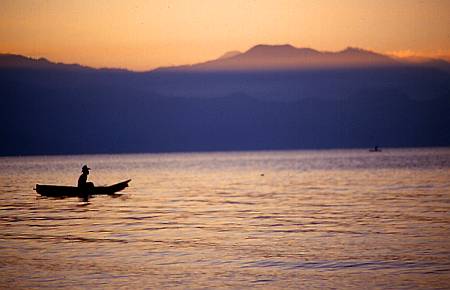
Lake Suchitlan, Suchitoto, El Salvador

Our photo of Lake Suchitlan, Suchitoto, El Salvador was chosen as Photo of the Day on Feb 5th 2010 in Gadling.com, AOL's travel blog.
Lake Suchitlan


Flickr user Adal-Honduras took this shot of El Salvador's Lake Suchitlan, a popular weekend getaway for many Salvadorans. Located near the beautiful, colonial town of Suchitoto, Lake Suchitlan is one of the most gorgeous spots in perhaps the Western Hemisphere's most underrated country. ~ Aaron Hotfelder.
It is indeed a very beautiful place. The photo was taken from La Fonda del Mirador, a nice old house with a rustic but comfortable setting, while enjoying a delicious local-style prepared fish stuffed with shrimps:
La Fonda del Mirador, Suchitoto - El Salvador

Miami Garifuna Village, Tela. The Coast of Utopia -Condé Nast

I found this old article about Miami Garifuna Village in Tela, Honduras. Written by Alison Humes Features Editor at Condé Nast Publications.

Lunch in Miami, one of the tiniest traditionally Garifuna communities sprinkled along the Atlantic coast of Honduras, was a profoundly satisfying moment, when all the contradictions of the world came together. The village lies at the end of a sand barrier, straddling the narrow ribbon of land that seals Los Micos Lagoon off from the Caribbean Sea, west of the small town of Tela. It is just inside the Jeannette Kawas National Park, one of Honduras's largest, a magical mix of cloud forest, estuaries, mangroves, and beaches. Walking through the village felt almost like trespassing; there are no streets, only paths between the small houses, all built of thatch and reeds. The sand sparkles, and there are little decorative gardens around some of the houses. There's no electricity or running water. The cayucos, boats carved from tree trunks, were pulled up on the shore of the lagoon, but if it's early enough in the day and you ask around, someone will take you out fishing or touring the enchanting lagoon. There was a breeze off the ocean, and we sat down at Nany's Place, along benches and picnic tables. I got a green coconut with the top cut off so I could drink its cool water and scrape the jelly out with a spoon. We lingered under the palapa, with the beach on one side and a view of the lagoon on the other, drinking beer and chatting with whoever came by to hang out.